Thursday, April 15, 2010
"The Revolution Will Not Be Televised"
The title made me do it. I picked Joe Trippi's book, "The Revolution Will Not Be Televised" because the title has a connection to a personal experience that I had as a reporter. Back in 2002 (may be it was a year later, I don't recall exactly), the news broke of a coup d'etat in Venezuela, just a few months after I had interviewed President Chavez while he was visiting the U.N. in New York. When I heard the news, I was a little concerned about his security and to be honest, his life. It's not that I like Chavez' policies, but when something like that happens it can end tragically. But Venezuelans had other plans. During the time he was out of power, thousands of Venezuelans protested in the streets and, miraculously, Chavez was back in the presidential palace after only a few hours. Believe it or not, while they protested in the streets, Venezuelan TV was showing the "new government" press conferences' or airing soup operas (at the time, most stations were against Chavez regime and supported the golpistas). During that time, two film makers who were in Venezuela recorded the whole ordeal which became a documentary, "The Revolution Will Not Be Televised." But Joe's book has nothing to do with this event, I found out later. The original "Revolution" title it's a poem and song written by an African American writer linked to the Black Panther movement. I heard the song the other day and kind of liked it. You'll hear more about the book next Monday.

Monday, April 12, 2010
The "Making" of Chatroulette

My friends (a la John McCain) I'm doing a story about Chatroulette soon and my thought is, who else should I ask for advice but the experts at APOC? I tried the website last week and it was distasteful (to say the least), but it had also an intriguing element. It's a great concept, no wonder why Google wants to buy it. Thinking about my audience, mostly parents, what should they know about Chatroulette? Any ideas?
Can Gaming Make a Better World? Yeah, right...
You saw the presentation, you were impressed...now, do you really believe it? Can playing games really create the environment to change our society's problems. I went to visit Evoke's website (still haven't play it) but it feels that one is not wasting time there. Which leads me to the poll of the week: Can Gaming Make a Better World? Go vote!
Hispanos 2.0
The reading for today's class is eyeopening, to say the least. Don't you agree? I really enjoyed Jane McGonigalon on TED's website. While I was reading the assignment I checked the "Hispanic Market" section on the Future of Media blog. I would like to do this for you, to save you sometime: synthesize the main points that the writer makes about the Hispanic market and give you my make take on it. What should you know this? Well, if you're going to work in social media or will have your own business, chances are that you will have to deal with Pedro or Jose or in a worst case scenario with Roberto. So, Maria Lopez-Knowles wrote the myths and truths of the Hispanic market (my comments in parenthesis).
1. The Hispanics market is Spanish language dominant. Myth.
"U.S. born Hispanics are English-language dominant and engage with English language media (60% of today’s Hispanic market), while the first generation (40% of the market) is primarily Spanish-language dominant."
(I agree, to a certain extend. It depends on the market. If you're in Miami it's Spanish Language dominant. In L.A? Probably English.)
2. The Hispanic Market is not online: Myth
"second-generation Hispanics spend more time online than with any other medium. In fact, among Internet users, more English-language dominant Hispanics have a blog than ANY OTHER demographic group (eMarketer.com)."
(I agree 100%, but I will also note that the first generation [immigrants] are becoming very active recently)
3. The Hispanic Market is brand loyal: Myth
"First generation Hispanics show much greater brand loyalty than second-generation Hispanics; yet, the second-generation is the brand influencer within a multi-generational family."
(Agree. Except it goes both way, depending on the product. What I mean to say is that "mama" will influence her kids about certain products [for instance, food] and vice-versa).
Lopez Knowles seems to count "third generation" and "fourth generation" as part of the Hispanic market. I have my doubts...when do you stop becoming "Hispanic" american? It depends, but if you lose your language, connection to your ancestry, and you were born here... can we just call you an "American"?
Monday, April 5, 2010
Twittering from Mexicali
A few minutes after the 7.2 earthquake that hit the Mexicali area, there were people twittering pictures of the damage. It was real impressive how quick people were sending the pictures to the web. When I clicked on the Google trend link about the earthquake, I could see real time tweets about the earthquake. Once again, just like in Chile, it was Twitter the first at the scene. ABC local was using those same pictures (from Twitter) on its live coverage. While NBC and Telemundo were sending a reporter to the border (Calexico), those pictures were already telling the story. Once again, it's changing how stations are covering and will cover breaking news. How? I don't know, but the technology is way faster than any TV network or station.
Friday, April 2, 2010
Could Social Media Revive the U.S. Economy?
There's little doubt of the effect that social media has on existing businesses. For instance, Yelp.com has done miracles for local businesses and we know how YouTube and Facebook could make or break a brand. But can social media drive the recovery of the U.S. economy?
Latest report: The economy adds 162,000 jobs in March
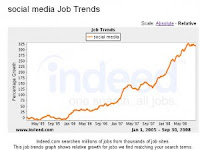
This is a chart of Social Media related jobs growth in the past years. The graph stops in 2008, so I'm sure the growth is even more impressive now...
Latest report: The economy adds 162,000 jobs in March
This is a chart of Social Media related jobs growth in the past years. The graph stops in 2008, so I'm sure the growth is even more impressive now...

The jobs have increased +300% from 2005 to 2008. This is great news for social media enthusiast like us. Facebook could be worth 100 billion in 2015, according to some analyst. This is only one company. Google is currently valued over 135 billion. With those type of numbers, one wonders how powerful these companies are getting and how many jobs they can create with their net profits? I think they can do a lot, not counting the new services or strategies that they bring to improve the growth of existing companies (i.e. how Realtor.com benefits from Google maps). Could this be just the beginning of a huge economic boom?
Monday, March 29, 2010
It Doesn't Look Good for the I-pad...

A recent poll found that 66 percent of respondents were not sure or will not buy an I-pad (above picture courtesy of Wikipedia). The rest said that they will wait for the price to drop before buying it. The poll was conducted a month after Apple's CEO, Steve Jobs introduced the computer on January 27. The I-pad cost starts at $500.00 and goes up depending on the hardware features. Media reception to the computer has been mixed, according to the Wikipedia entry on the subject. Walt Mossberg called the price "modest" for a device of its capabilities, and liked the ten-hour battery life. Yair Reiner said that, "the iPad will compete against e-book devices such as the Barnes & Noble Nook and the Amazon Kindle." The unscientific survey was created by Enlacalle with a sample of 3 people. I hope you vote next time for a more representative sample. My new survey: Should Google pull out of China? Go to Enlacalle.
Words Are Important

As you can see from this sign at the front desk of Santa Ana's police station, words in the right context, are extremely important. I still trying to figure out the meaning of the sign. Could it mean that if you are a gang member, you could register from 8 to 11 in the morning? Would you really want to register with the police if you were a gang member? May be if you want to register your gang you can do it...hum... that doesn't make any sense either. Anyway, we recently went over SEO strategies in both classes, Mondays and Wednesday. I believe it's one of the most important topics for any new website, no matter the business model that you choose. It's critical for the ranking of your page on a search result. Remember that 90 percent of the clicks will happen in the first page of the results. Some of the results will be influenced by "keyword" usage. A few weeks ago, I registered with SEOBOOK and I wanted to share some of the lessons you can get for free. You could go to SEOBOOk website and get a free account. It's very simple and useful. After you register, you will be getting some tips. For instance, on key word density they explain that,
"Your on page SEO strategy should use semantically related phrases and mix up your keyword usage. If your page title is "Chicago Dentist & Dental Care : Business Name" then your on page heading tag should be something like "Your Friendly Dentists in Chicago".
They advise not using the same words so many times because it may be too "Spammy", instead...
- Singular vs plural forms of a keyword
- Use synonyms
- Add in relevant keyword modifiers
- Change word order
If you want to learn more, you know what to do...and may be you can help me understand the sign, leave a comment.
Monday, March 8, 2010
Local Stations Searching Twitter, Facebook for News?
 I recently heard that local TV news departments are using Twitter, Facebook, etc to find stories. Well, let me rephrase it, the local morning newscasts have dedicated a few assignment desk editors to look for "trends" online, so they can assign stories on what some people are posting. Not a bad idea, but what makes news these days? Ok, if a video of a cat playing the piano is suddenly popular on line, should it make it to the local newscast? Most news reporters that I talked to are not happy about it. And it's not because they think they're above that, it's because we are becoming more like TMZ (no disrespect, Josh) and not what we were created for. Suddenly, we want to become "cool", web centric. We are TV local news. We're not cool. So, instead of embracing the technology to improve our product, we are embracing the products that have been highlighted by the new technology (specially here in LA, any content that has to do with Hollywood and Paris Hilton). I'm currently reading, "The Revolution Will not be Televised.." by Joe Trippi. Trippi makes the argument that Howard Dean's campaign for the 2004 election was the result of our current social media tools. Dean's staff was able to raise a huge amount of money through small on line donations. At the end, we all know how Howard Dean ended, but the seeds for a new way to finance campaigns were planted. Trippi also argues that the conventional media really disliked Dean, in part because his staff circumvented them. Now the same conventional media seems to be trying to become a mirror image of the online space. How sad. Now we see all these anchors preaching "follow me on Twitter" or "talk to me on Twitter". Don't believe the hype. Most of them won't talk to you, not even in person if they had the chance. Ok. May be you can talk to them on Twitter, but that doesn't mean they will talk to you.
Welcome to the new Enlacalle, powered by SEO
As you can see, I have updated my design. It's still not as good as many of you. If you want better ideas check Jesse's or Christopher's I'muphere and, of course, one of my favorite ones: Thadoghouse. Anyway, I did a couple of things to improve my dismal web traffic, using a couple of SEO tactics. First, I included a new set of links to all of your blogs. This is basically to help you get one more visitor (myself) and more important get me a better page ranking when they search for a key word or this blog. I also included more content in the form of a poll. If you're reading this using google reader, go to my blog and vote: would you would buy an I-pad? Both elements were really simple to create and only took sometime because I'm really awful at using Blogspot. Anyway, I took all the links from our Apoc intro wiki page, so if you don't see your link is because there's a problem with the link you provided on the page. Thank you for reading and comeback again.
Monday, March 1, 2010
Power Law Distributions and Brand Evangelism
Clay Shirky points out how the Power Law explains how content is created on the on-line space. The web is full of examples of this "great imbalance" of participation, like Wikipedia. More locally, for instance, when I was trying to look for the restaurant with the best Yelp's ranking in Burbank I found it was Studio Cafe Magazzino with four and half stars. The restaurant has been reviewed (until this afternoon) 43 times. From those 43 reviewers only six had written 200 or more reviews in total. From those six one had more than a 1000 reviews and the second close to him had about 500. This is really helpful to understand online communities, in particular corporate communities. How important? I believe that those super contributors can be target to become a x-brand's evangelist. These fans will be the people retwittering and blogging about your ideas and products. This also changes the dynamic of mass media advertising. As a company, why would you spend a lot of your resources to randomly targeting your prospective costumers if you could just win the trust of your fans to take the message more effectively? I don't know. And I still haven't tried Studio Cafe and when I do I won't be writing a review.
Chuck Liddell and Girlfriend Naked Workout - Viral Ad

Here's the link so you can have your own thoughts about it. The video is a viral ad from Reebok that's causing a lot of buzz in the web. It shows MMA fighter Chuck Liddell and his girlfriend working out naked, wearing only Reebok Zigtech shoes. I learned about the video this Saturday while I was reading a blog from a Miami Herald's sport writer. Mashable has an entry about it. There's no doubt that the ad will get a huge amount of visitors, just like other Reebok's ads that follow the same concept in the past. First, it's controversial. Second, Liddell + Girlfriend nude = a lot of hits. How will it engage consumers? It's hard to tell right now because the campaign just started. One of the comments left in Mashable by a man says that after watching the ad with his girlfriend, she wanted to buy the lingerie that Liddell's girlfriend was wearing. Another one complains that kids are being bombarded by too much sex already. I believe that the ad has already accomplished one of it goals: attention. How that will translate into sales remains to be seen.
Sunday, February 28, 2010
Health Care Summit
This has nothing to do with our class, but I wanted to share my two cents on healthcare, now that the White House and the Congress are taking another (perhaps final) look at how to fix the system. Last year, after a mild pain in my back I decided to visit a doctor. First, I made sure it was in-network and close to work. After my first visit, the physician said that he wasn't sure what it was and that he need a MRI to see my lower back. Before that, he needed to take x-rays because the insurance wouldn't approve the MRI before the first procedure. I lost another day of work to got to the lab. A week later the results didn't show anything. He ordered an MRI. Right in front of me he got the approval over the phone (at least that's what he said). Went to the lab again and waited a week for the results. In the meantime, the doctor prescribed to me an anti-inflammatory drug like Motrin. When I got the results, I was already feeling fine. The doctor said that nothing looked particular worrisome and could had been a nerve in my back. Almost year after, I got a bill from the MRI place for a few thousand dollars. They said that the insurance did not pay. I called the insurance and they said that the doctor didn't follow the right steps. I called the doctor and he said that it was the insurance's fault. Nobody wants to pay, but there's only one name on the bill. The insurance, by the ways, is from GE, one of the biggest companies in the world, in the richest nation in the world, with the "best" healthcare system in the world. What a joke!
Chile, Chilenos, and Texting
 By this time, we all know what happened in Chile this weekend. Chileans love "futbol" (the picture on the left is from Colo-Colo, the most popular soccer team in the South American country). I met many chilenos when I lived in Miami. We used to play soccer for hours, young and old, in the same field. Chile is a great example for other South american countries. After years of a military dictatorship, it transformed itself to a prosperous and stable country, without firing one bullet. I had already booked a trip to Chile for this summer when I learned about the earthquake on Saturday. I'm still going because the country will be ok by then, I believe. Of course, Chile will need help. There are new campaigns to raise money using texts. These campaigns are very simple, you just need to text a key word and a donation is charged to your account. Could this be the start of a new model to gather donations? It proved very successful with Haiti, but I don't think it will be as impressive with Chile. One of the reasons is that you won't see as much damage (even though the earthquake was more powerful) in Chile. We will have to wait and see how the people respond. I'm afraid that if we keep seeing the same tactic applied to the latest tragedy people may get tired of it. With those questions aside, it's great to see technology working for a good cause.
Sunday, February 21, 2010
Should a Small Business Have its Own Community?
 How big should a business be in order to invest in an online community? I've been thinking about this since we started our class. My feeling is that most small business should use the available free tools (facebook, twitter, etc) to interact with their costumers before spending their resources. On the other hand, with sites such as Ning.com there are available resources to build it without a lot of money. This Monday, we'll know more on how to manage a "new" kind a corporate community. How to engage the users in a different way (not the usual PR crap). Can the same tools be applied to small businesses?
Have You Driven a Ford Lately?
I don't know about you, but Ford seems to be putting a lot more effort in building better looking cars. The Fusion, for instance, looks as sharp as a VW. We'll have to wait about the quality of these new generation of cars, but the company posted some gains lately and seems to be on the rebound. Social media is right in the middle of the new Ford strategy. I just saw this video
It's presented by Scott Monty, who is charge of Social Media for Ford. He shows insightful examples how to use social tools like Facebook and Twitter as a way to get feedback and interact with your costumers. Among the useful things: On Twitter, Ford has different accounts for specific niches (you don't want to mix the "Ford Green" with the "Ford Mustang" message). Scott tells a story about a blogger who posted that he wasn't sure about buying a Ford car and asked for the CEO of the company to give him a call. He got the call, thanks to Scott who noticed the post. The overall strategy is to make "humanize" the Ford brand. After watching the presentation, I'm not giving up my VW, but he got me thinking.
Zero to 60: Ford’s Social Media Story, by Scott Monty; presented by GasPedal and the Social Media Business Council from GasPedal on Vimeo.
It's presented by Scott Monty, who is charge of Social Media for Ford. He shows insightful examples how to use social tools like Facebook and Twitter as a way to get feedback and interact with your costumers. Among the useful things: On Twitter, Ford has different accounts for specific niches (you don't want to mix the "Ford Green" with the "Ford Mustang" message). Scott tells a story about a blogger who posted that he wasn't sure about buying a Ford car and asked for the CEO of the company to give him a call. He got the call, thanks to Scott who noticed the post. The overall strategy is to make "humanize" the Ford brand. After watching the presentation, I'm not giving up my VW, but he got me thinking.
Wednesday, February 17, 2010
Steve Jobs - The Salesman


It's fascinating how Steve Jobs seems to use the media to improve Apple's stock. This article makes the same case by pointing out Job's "Sneakiest Statements." In it, the Apple CEO says that he's not convinced that people want to watch video or movies in a small screen. That was in 2003, but we know that two years later the I-pod was playing video in tiny screen. Another one was in 2008 when he said that the Kindle had no future because people were not reading anymore. One more: "We didn’t think we’d do well in the cellphone business," said in that same 2003 interview. Before announcing the I-pad, Jobs said that Apple couldn't make a $500 computer that wasn't, "a piece of junk." This led the experts to think that the tablet would cost around $1000. However, you can get the basic version of it for $500.
Are those statement to trick the competition? Or may be to confuse the experts about pricing so when the products is unveiled it actually cost less than what most gurus agree? Or could it be that when CEOs are asked to predict the future of technology, even them, are not going to be right a 100 percent? I think is a combination of the many factors, but I'm convinced that he's a great salesman. And when he said that Apple couldn't make a computer for $500 that wasn't a piece of junk... he's still right!
Tuesday, February 16, 2010
One last look at Twiistup


I wasn't able to attend Twiistup, but I feel that most people learned a lot of new things about the online business. One great example, if you haven't read it, is Lisa Jacob's blog about her experience. She was able to listen to Paul Graham"s interview about start ups. After reading Paul Graham, he has become one of my favorites bloggers and entrepreneurs. This guy gets it.
Back to Lisa's blog, she has a few main points about Mr. Graham. First, he dressed down, a sign of how confident and successful this guy is. This happens in many professional fields. A few years ago, I met legendary anchor Dan Rather while I was walking in a hallway of the CBS building in New York. Those who have been there know that the building is very old. Confusing. I was lost when I saw him. He was really nice and talked for a few minutes, and then even showed me the way out. It may sound new to you, but most anchors that I know wouldn't do that. But the really talented ones, in my opinion, seem to be comfortable enough to be nice to "general assignment" reporters like me.
Paul Graham fits that category. He sounds like a winner and also makes it clear. He advises to be determined and think big when you're building a new project, a website. More important, build something that people need. A great advise that sometimes gets lost in the excitement.
Sunday, February 7, 2010
Super Bowl Ads and Flo TV
ManCrunch Crunches the Super Bowl Ad Game... Scott Sles analyzes in his blog how Mancrunch outsmarted the media (in this case CBS) and benefited from the controversy of not being able to buy space in the Super Bowl. I agree. It was a great way to get publicity without paying for it. He also mentions that he wasn't impressed with any of the ads. I have to disagree with that one. I thought that the Google commercial was really smart and told a story in a very simple but emotional way.
Another commercial that captured my attention was Flo TV. It was not because of the ad, but for the product. I'm not sure about how new the technology is (I believe the I-phone has similar capability) but with the Flo TV device you can watch TV from any place you have a connection. There are three ways to access it: through your cell phone, your car entertainment system and with your personal television. The price of the small TV was $200 on Amazon.com. I checked Flo's website and couldn't find the subscription price.
Could this be a great way for TV to recover some of the advertising money? I think this could be part of the solution. The service will give viewers a way to watch their shows anytime they want, but also be able to get live news or sport events, even in their cars and with a clear picture and no download waiting time (at least that's what they promise). The device is small enough that you can carry in a purse or even your pocket, but it should have a better picture quality that most cell phones. That should make it attractive. How about competitors? May be the I-phone, but I can't think of others. It has great potential because I believe that eventually these mobile devices will find a way to incorporate the internet to their products. It will be interesting to see how and when.
Ning.com

Building a social network in less than 30 seconds. Needless to say, it took me about 15 minutes, but after trying Ning I was shocked to see how easy was to build my own community. I decided to build one for me and a few guys from work who get together every Saturday (rain or snow!) to go play soccer in the morning. Once you register with an e-mail address, there are about 20 templates to choose from to start your page, so there is a lot of ways to make it look like if it were original content. Then, there many ways to customize it by importing your background or a logo for a header (these are the things that I tried, but I'm sure there are many other functions that you can do to build it). A really cool feature is that you can import (I don't know if I'm using the right word here) applications. For instance, I picked HULU to be part of the main menu. So, whenever I get a new member, the member will able to watch a sport channel courtesy of HULU. You can add more widgets to your own network. For many of us looking to built a web base business, these tools are a really affordable tools to make a website attractive. Another example that we study this week is KickApps. You don't really need to spend a lot of money, the services and platforms are already there.


Subscribe to:
Posts (Atom)
